In the sparsely populated span of the northeast Texas Panhandle, the Lipscomb County Courthouse stands as an enduring symbol of civic pride, architectural heritage, and the unwavering spirit of a close-knit community located truly at the Top of Texas. Situated in the diminutive county seat bearing the same name as the county itself, the 1916 Classical Revival courthouse in Lipscomb is more than just a government building; it is the heart of a county and a persistent testament to a town of fewer than 100 residents and a county that possess a charming remoteness fitting for the Texas Panhandle.
Photograph by Austin Allison
Established in 1876 and organized in 1887, early residents of the county initially conducted affairs in an unassuming one-story wooden courthouse erected in 1888. Designed by E. M. Fennell and C. C. Elybs and constructed by contractors Goff and Condon, this first structure served the burgeoning county as its population steadily grew. As the 20th century came and with a subsequent increase in population from expanding farms and ranching operations, the need and desire for a more substantial and symbolic seat of the county’s government became apparent.
In December 1915, county voters approved bonds valued at $25,000 for a new courthouse. Prominent Amarillo architect and general contractor William M. Rice was chosen to design and oversee the construction, with Rice choosing Edward S. Altmiller to serve as the construction’s superintendent. Altmiller had previously constructed the 1910 county jail. Weeks after the initial bonds were approved, it was determined that the bond value should be raised by $10,000 to effectuate the funding of a more grand building. With major completion completed in late 1916 and final improvements finished by March 1917, the new Lipscomb County courthouse rose on the plains as an imposing two-story structure atop an accompanying semi-basement that still resonates today.
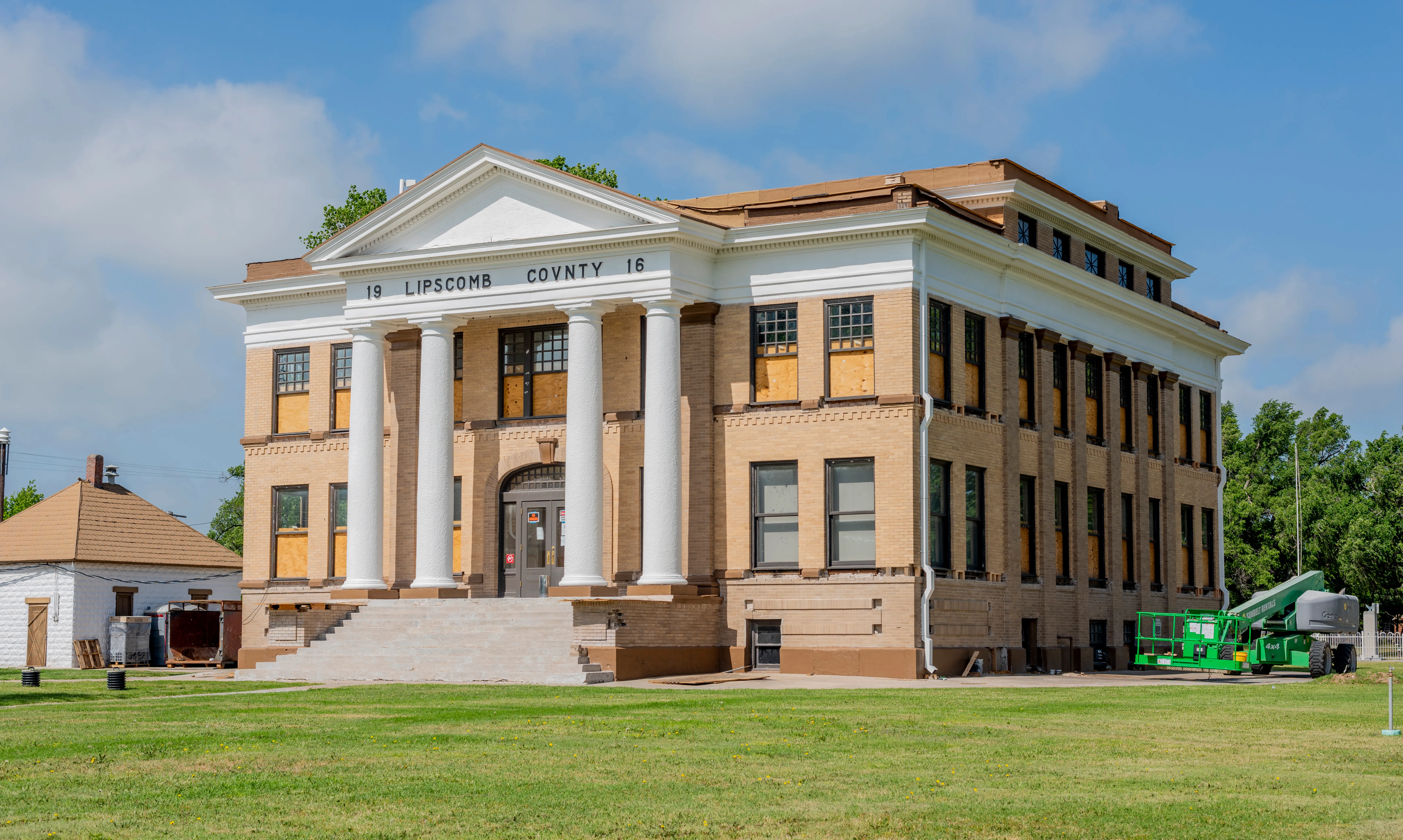
Rice’s design embraced an increasingly common Classical Revival style that was a popular choice for public buildings of the era, signifying both stability and tradition. The courthouse is adorned with tan-colored brick, originally intended to be “No. 1 Elgin-Butler face brick,” and four distinguished but stately Doric-style columns at both east and west entrances. These entrances also feature gabled porticoes that are crowned by simple Greek-style pediments. These grand entrances, approached by broad concrete steps, lend an air of gravitas and permanence to the structure. The structure incorporates subtle Prairie Style influences on its north and south elevations, reflecting a blend of classical grandeur with American architectural trends. The north and south facades indicate the presence of an attic that was originally not accessible, but later renovations opened this space for use.
The courthouse is strategically situated in the center of the courthouse square, a traditional layout that emphasizes its importance as the county’s governmental and social nucleus. In fact, the community of Lipscomb itself lies but a short distance from the geographical center of the county. Despite the town being bypassed by the railroad, a development that often sealed the fate of many frontier towns, the presence of the courthouse ensured its continued designation as the county seat. This sentiment underscores the vital role the building played in anchoring the community and county as it existed in the extreme northeast corner of the Texas Panhandle.
Throughout its century-long existence, the Lipscomb County Courthouse has not only served as the center for judicial and administrative functions but has also been a silent witness to the county’s history, a backdrop for community gatherings, and a symbol of local identity. Its significance is formally recognized through its designations as a Recorded Texas Historic Landmark, a State Antiquities Landmark, and its listing on the National Register of Historic Places in 2008, noted for its impact in both county government and its architecture.
The passage of time took its toll on the historic structure. Recognizing the need to preserve this cherished landmark and renew its vitality for the 21st century, citizens of the county embarked on an ambitious restoration project that took more than two decades to fully realize. This endeavor, a testament to the community’s dedication, originated in 1999 as community leaders sought to restore the structure. As a participant in the Texas Historical Commission’s esteemed Texas Historic Courthouse Preservation Program (THCPP) following a 2018 grant, the courthouse underwent a comprehensive restoration that was completed in 2021.
The meticulous restoration was rededicated on September 11, 2021 and addressed nearly every facet of again making this building a sentinel in Lipscomb County. Work included crucial masonry repairs, a new roof, and the removal of incongruous modern additions like suspended ceilings. Interior finishes were restored based on historical analysis that resulted in the revival of the structure’s original grandeur, including that of the district courtroom and its balcony. Modern necessities were seamlessly integrated, with new mechanical, electrical, and plumbing systems installed alongside contemporary security features. A significant improvement was the installation of a new internal elevator, replacing an exterior one added during the 1970s, thereby enhancing accessibility while respecting the building’s historic fabric. Prior to this major undertaking, the courthouse windows had already been restored in 2014 through a THCPP emergency grant.
Today, the fully restored Lipscomb County Courthouse stands proud as a beacon of the northeast Texas Panhandle. The imposing courthouse serves as a powerful reminder of civic continuity and the enduring strength of its residents. It remains the most prominent historic building in one of Texas’s least populated county seats, continuing to function as the active center of government and politics and a steadfast witness watching over the plains and the people it serves.